

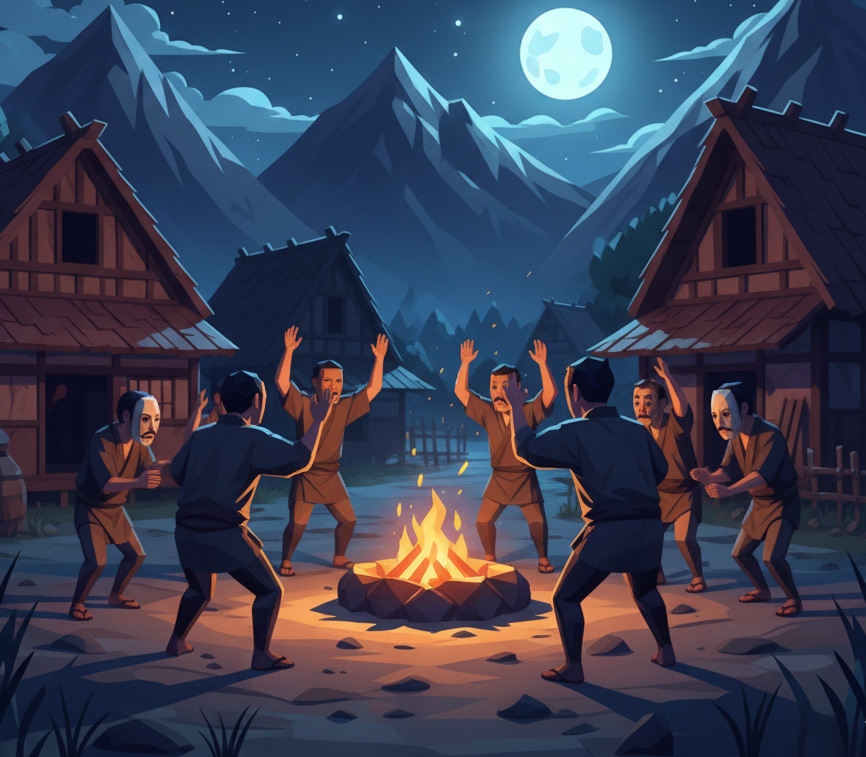
Japan has a long history of unique village customs, many of which seem shocking or bizarre by modern standards. These traditions were deeply rooted in the survival, religious beliefs, and social structures of rural communities. Here, we introduce 10 strange and fascinating customs that once existed in Japan’s villages.
1. Yobai – The Secret Night Visits for Love
(Throughout Japan – From the Edo Period to the Meiji Era)
In rural Japan, a peculiar courting practice called “Yobai” was once common. Unmarried men would secretly sneak into the houses of unmarried women at night to express their affection. If the woman accepted the man’s presence, they would spend the night together, and over time, this could lead to marriage.
- A secretive yet socially accepted way to form relationships
- Women had the right to reject the man’s visit
- Helped maintain close-knit village relationships
Though it might sound shocking today, this practice was a recognized method of matchmaking in some communities.
2. Infanticide & Abandonment – The Dark Side of Survival
(Throughout Japan – Edo to Meiji Period)
Due to extreme poverty, many villages practiced “mabiki” (infanticide) or abandoned babies in temples. Families who couldn’t afford to feed their children were forced to make heartbreaking choices, often targeting girls or disabled children.
- Some temples became sanctuaries for abandoned children
- Harsh living conditions forced families to make cruel decisions
- The practice was eventually banned in the Meiji period
This tragic practice reveals the extreme hardships that rural communities faced.
3. Mura Hachibu – Social Exile from the Village
(Throughout Japan – Edo to Showa Period)
Mura Hachibu (“Village Eight Parts”) was a severe form of social punishment. A person who broke village rules or caused trouble would be completely ostracized, with no one talking to them or helping them.
- The person was cut off from all social interactions except funerals and emergencies
- Could lead to total isolation and forced relocation
- A powerful way to maintain strict village order
The concept of “social exile” still lingers in modern Japan, though in a much less extreme form.
4. Kamuy-nomi – Ainu Rituals of Nature Worship
(Hokkaido & Northern Honshu – Until Modern Times)
The indigenous Ainu people practiced unique religious ceremonies known as “Kamuy-nomi,” where they worshipped nature spirits (Kamuy). One of the most famous rituals, Iomante, involved raising a bear cub with care and then sacrificing it to send its spirit to the gods.
- A spiritual belief that everything in nature has a soul
- Bears were seen as divine messengers
- Still practiced today as part of cultural preservation
This custom reflects the deep spiritual connection between the Ainu people and nature.
5. The Bride of the Serpent – Marrying a Snake God
(Yamagata Prefecture – Edo Period)
In a village legend, a young woman was chosen to become the bride of a serpent deity. The villagers believed that marrying a divine snake would bring prosperity and protect the village from disasters.
- A ritual to ensure harmony between humans and the divine
- The bride would serve as a priestess rather than literally marrying a snake
- Similar snake deity legends exist across Japan
These kinds of myths reveal how deeply religion and nature worship were embedded in village life.
6. The Hidden People of the Mountains – The Mysterious Sanka Tribe
(Throughout Japan – Edo to Showa Period)
The “Sanka” were a nomadic group in Japan who lived in remote mountains, completely separate from ordinary villages. Their way of life remains mysterious, with some believing they were descendants of an ancient, lost race.
- Did not use writing, relying on oral tradition
- Made a living through unique craftsmanship and trade
- Disappeared in the 20th century, but legends remain
Even today, some claim that descendants of the Sanka still exist in hidden areas of Japan.
7. Kudaka-san – Okinawa’s Female Religious Leaders
(Okinawa – Ancient Ryukyu Kingdom to Meiji Era)
In Okinawa, spiritual power was held by women, and priestesses known as “Noro” or “Kudaka-san” had a higher religious authority than men. They performed sacred rituals and were considered intermediaries between the gods and the people.
- A unique matriarchal religious system in Japan
- Conducted ceremonies for fertility, safety, and peace
- After the Meiji era, these traditions gradually declined
This rare female-led spiritual practice highlights Okinawa’s distinct culture.
8. The Oshirasama Faith – A Tragic Love Story Between a Girl and a Horse
(Tohoku Region – Edo Period and Beyond)
Oshirasama is a folk deity believed to be the spirit of a girl who fell in love with a horse. According to legend, her father, enraged by the taboo relationship, killed the horse, causing the girl to die of grief and ascend to heaven.
- Worshiped as a deity of agriculture and family protection
- Oshirasama dolls are wrapped in silk and prayed to in homes
- A rare fusion of mythology, tragedy, and religious faith
This folklore reflects the deep connection between humans and nature in rural Japan.
9. The Kappa Exorcism Ritual – Keeping the River Monster Away
(Kyushu and Tohoku – Edo Period to Present)
The Kappa, a mythical river creature, was feared for drowning people and stealing crops. Some villages performed special exorcism rituals to appease or drive away Kappa, offering cucumbers (their favorite food) and chanting protective prayers.
- Kappa were seen as both mischievous and dangerous
- Shrines and warning signs still exist today
- One of Japan’s most famous yokai (supernatural beings)
Even today, festivals honoring Kappa are held in certain areas.
10. The Fox Bride Procession – Honoring the Trickster Spirits
(Various Locations – Edo Period to Present)
In some villages, fox spirits (Kitsune) were believed to control the fate of marriages and businesses. Villagers would hold mysterious night processions, wearing white fox masks and lanterns, in order to appease the spirits and ensure good fortune.
- Foxes were considered messengers of the gods
- Shinto beliefs played a major role in these rituals
- Modern festivals still reenact the “Fox Bride Procession”
Fox spirits remain one of Japan’s most enduring supernatural beliefs.
Conclusion
Ancient Japan had a wide range of unique and sometimes eerie customs that reflected the people’s deep connection with nature, religion, and social order.
- Some customs were necessary for survival, even if they seem extreme today.
- Religious and supernatural beliefs strongly influenced daily life.
- Many traditions have faded, but traces still remain in modern Japan.
These bizarre and fascinating customs offer a glimpse into the mysteries of old Japan.