

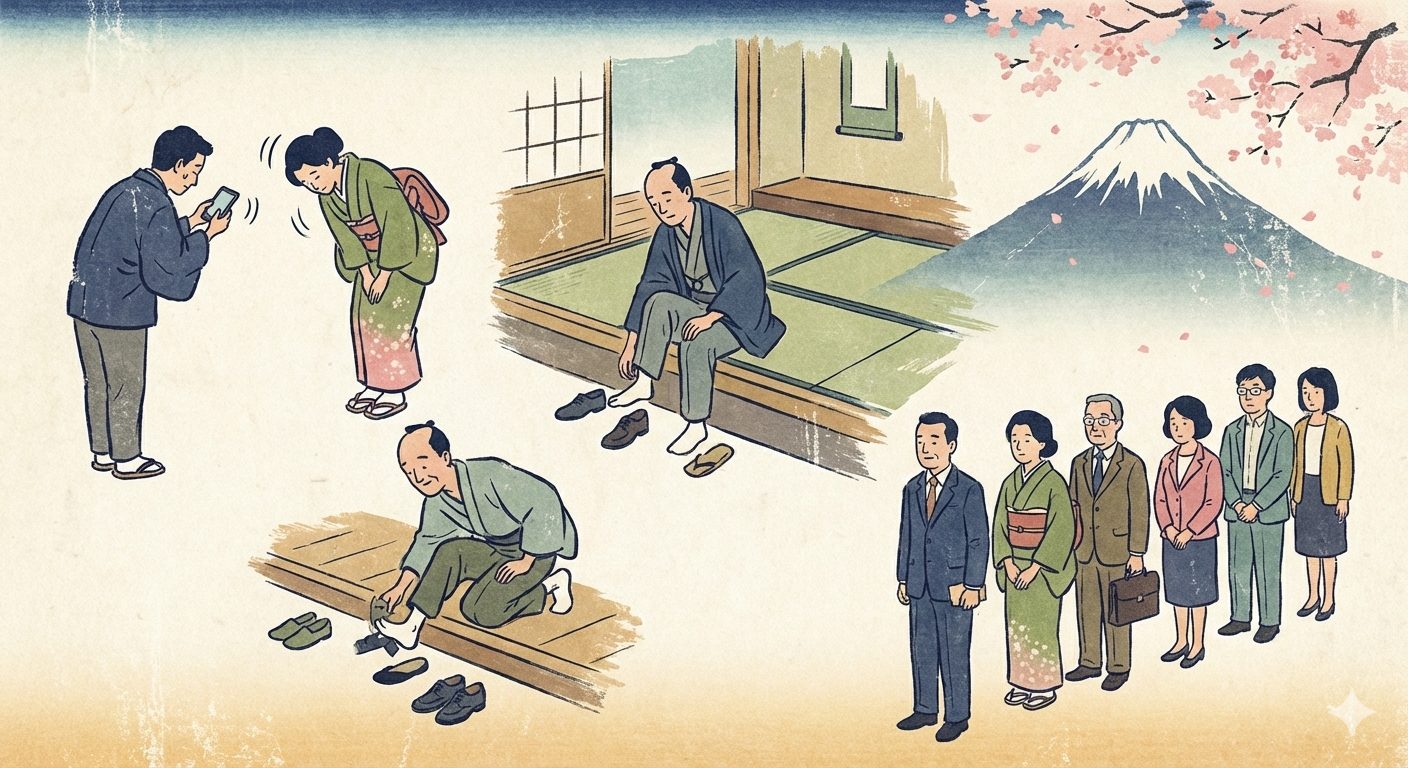
— Unusual Etiquette Born from Japan’s Unique Culture —
Japan is known for its rich traditions and meticulous etiquette, many of which may seem unusual or even bizarre to people from other countries. These manners are deeply rooted in Japanese history, culture, and values, but for first-time visitors, they can be quite surprising. Here are 10 Japanese manners that the world finds strange.
1. Taking Off Shoes Indoors
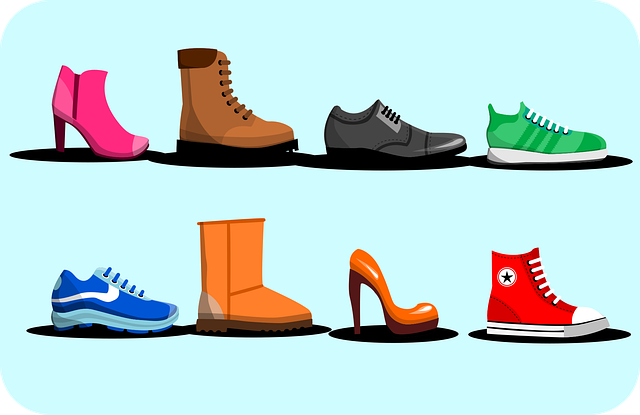
In Japan, it is customary to remove shoes before entering a home. This practice is meant to keep the indoor space clean, but in many countries, people keep their shoes on inside the house, making this rule seem odd to them.
✅ Strange Points:
- People also switch to indoor slippers in schools and hospitals.
- Some restaurants and inns require guests to take off their shoes.
- There are special slippers for toilets only.
2. Staying Silent on Public Transportation
In Japan, it is considered good manners to stay quiet on trains and buses. Talking loudly or making phone calls is frowned upon, whereas in many other countries, public transport is often filled with chatter.
✅ Strange Points:
- Talking on the phone is discouraged, but texting and social media are fine.
- Even earphone sound leakage is seen as rude.
- People are especially silent in priority seating areas.
3. Bowing Instead of Handshakes
In Japan, people bow when greeting, thanking, or apologizing. While shaking hands or hugging is common in many cultures, the bowing custom can feel unfamiliar and overly formal to outsiders.
✅ Strange Points:
- The angle of the bow changes based on respect level (15°, 30°, 45°).
- A deeper bow shows greater respect.
- Foreigners often get confused when trying to bow and shake hands at the same time.
4. Saying “Itadakimasu” and “Gochisousama” Before and After Meals
Before eating, Japanese people say “Itadakimasu”, and after finishing, they say “Gochisousama”. This practice expresses gratitude for the meal, but since most countries don’t have an equivalent phrase, foreigners often wonder why it’s necessary.
✅ Strange Points:
- Even if you paid for the meal yourself, you still say “Gochisousama”.
- Some foreigners mistake it for a prayer.
- Children are taught this custom from an early age.
5. Receiving Change on a Tray Instead of Hand-to-Hand
At most Japanese stores, cash and change are placed on a small tray instead of being handed directly. This is meant to be polite and avoid awkward hand contact, but in many countries, direct hand-to-hand transactions are the norm.
✅ Strange Points:
- Some Japanese people feel uncomfortable receiving money directly.
- Cashiers always present the tray with both hands.
- Even credit cards are often placed on the tray instead of being handed over.
6. Strict Chopstick Etiquette
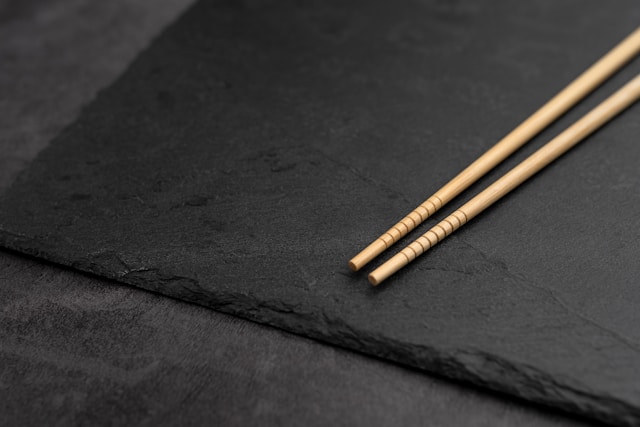
Japan has many rules regarding chopstick usage, and breaking them can be seen as rude. Foreigners often struggle to remember all the taboos, such as never sticking chopsticks into food or passing food directly between chopsticks.
✅ Strange Points:
- Sticking chopsticks upright into rice resembles funeral rituals.
- Passing food from one chopstick to another mimics a cremation ceremony.
- Licking chopsticks is considered bad manners.
7. Being Asked “Do You Need a Receipt?” at Convenience Stores
In Japan, store clerks always ask if you need a receipt, no matter how small the purchase. In many countries, receipts are given without asking, or only if requested, making this polite gesture feel excessive.
✅ Strange Points:
- Even for small purchases, clerks always ask.
- Many customers decline the receipt.
- Clerks also frequently ask, “Do you have a point card?”
8. No Trash Cans in Public, but No Littering
Japan has very few public trash cans, yet its streets remain exceptionally clean. Foreigners often wonder, “Where do people throw their trash?” The answer: they take it home with them.
✅ Strange Points:
- Public trash cans were removed after the 1995 Tokyo subway sarin attack.
- The “carry your trash home” rule is widely accepted.
- Even convenience store trash cans are often located inside the store.
9. Keeping Towels Out of the Bath in Hot Springs
In Japanese hot springs (onsen) and public baths, it’s considered bad manners to let your towel touch the bathwater. Some countries allow people to wear towels in communal baths, making this rule seem unusual.
✅ Strange Points:
- Many Japanese people place towels on their heads instead.
- Washing your body before entering the bath is a strict rule.
- Talking loudly in the bath is frowned upon.
10. Different Escalator Rules in Tokyo and Osaka

In Japan, people stand on one side of the escalator and leave the other side open for walking. However, in Tokyo, people stand on the left, while in Osaka, they stand on the right—a rule that confuses even Japanese travelers.
✅ Strange Points:
- Tokyo follows the left-standing rule, while Osaka follows the right-standing rule.
- The official rule is actually to stand on both sides and not walk.
- Some countries prohibit walking on escalators for safety reasons.
Conclusion
・ Japanese manners are detailed and unique, often surprising foreigners.
・ Many customs originate from a deep respect for cleanliness and politeness.
・ What seems “strange” at first often makes sense once you understand the cultural background.
Japan’s etiquette may seem unusual to outsiders, but they reflect the country’s values of order, respect, and harmony. Learning these manners can help visitors appreciate Japan’s culture even more!