

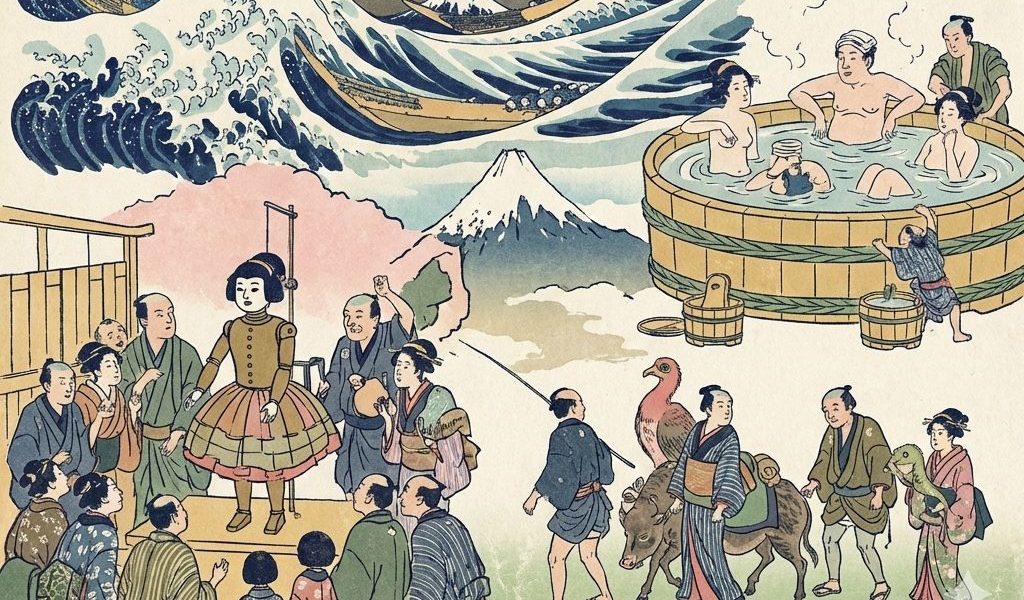
— Surprising Traditions and Innovations of Japan’s Edo Era —
The Edo period (1603–1868) was a time of peace, stability, and cultural flourishing in Japan. During this era, many unique customs, policies, and innovations emerged, some of which were surprisingly advanced for their time. Here are 10 fascinating cultural aspects of the Edo period that might astonish you.
1. The Law That Protected Animals – “Shōrui Awaremi no Rei”
Under Tokugawa Tsunayoshi, the fifth shogun, Japan saw the enforcement of the Shōrui Awaremi no Rei (Edict of Compassion for Living Things), which strictly protected animals, especially dogs. As a result, Edo was filled with stray dogs that could not be harmed, earning Tsunayoshi the nickname “the Dog Shogun.”
✅ Surprising Points:
- Killing or harming dogs was punishable by death.
- Special shelters called ōkubō yashiki were built to house stray dogs.
- Other animals, including birds and fish, were also given legal protection.
2. Edo’s Rental Bookstores – The Birth of Japanese Pop Culture
Reading was a popular pastime in Edo, and rental bookstores (kashi-hon’ya) flourished, allowing people to borrow books for a small fee. This was one of the earliest forms of public access to literature, similar to modern libraries.
✅ Surprising Points:
- Books were rented instead of purchased, making them affordable for the common people.
- Popular genres included samurai tales, romance, and humor.
- Some book rental shops even had illustrated picture books for children.
3. The Superhuman Strength of Edo’s Couriers – “Hikyaku”
Hikyaku (couriers) were professional runners who delivered messages, goods, and money across Japan at astonishing speeds. They could run over 200 km in just two days, making them the Edo-era equivalent of express mail.
✅ Surprising Points:
- They ran barefoot or wore straw sandals, replacing them frequently.
- They carried messages on small bamboo tubes tucked into their belts.
- Some hikyaku even covered over 500 km in just five days!
4. High Literacy Rates Among Women
Unlike many other pre-modern societies, Edo-period Japan had an impressively high literacy rate, including among women. Many girls attended terakoya (temple schools), where they learned how to read and write.
✅ Surprising Points:
- Edo’s overall literacy rate was estimated to be around 70%.
- Even commoner women could read and write, especially in major cities.
- Many women wrote diaries, novels, and letters, contributing to literary culture.
5. Edo’s Advanced Recycling System
Edo was a zero-waste society where everything was reused or repurposed. People repaired clothes, traded old goods, and even recycled used paper and candle wax.
✅ Surprising Points:
- Broken pottery was repaired using kintsugi (golden joinery).
- Used clothes were collected and resold by secondhand merchants.
- Human waste was collected and sold as fertilizer to farmers.
6. The Unique Bathhouse Culture of Edo
Public bathhouses (sento) were an essential part of daily life in Edo. People visited bathhouses not only to cleanse themselves but also to socialize and exchange news.
✅ Surprising Points:
- Men and women originally bathed together until the late Edo period.
- Some bathhouses were entertainment hubs, offering snacks and massages.
- Water was heated using scrap wood from carpenters and firewood merchants.
7. Catfish Were Believed to Predict Earthquakes
In Edo-period folklore, giant catfish (namazu) were believed to cause earthquakes by thrashing underground. People believed that observing the behavior of catfish could predict seismic activity.
✅ Surprising Points:
- Namazu-e (catfish paintings) were popular charms to ward off disasters.
- This belief led to one of the earliest forms of earthquake preparedness.
- Modern scientists have found that some fish species react to seismic changes!
8. Edo’s Nightlife Was Full of Fireworks and Festivals
Edo was known for its lively festivals (matsuri) and spectacular firework displays. The Sumida River Fireworks Festival, which began in 1733, was one of the grandest events of the time.
✅ Surprising Points:
- The firework competition between Tamaya and Kagiya became legendary.
- Some festivals lasted for days, with parades and performances.
- The entertainment district of Yoshiwara thrived with music, dance, and theater.
9. “Kawaraban” – Edo’s Version of Newspapers
Before modern newspapers, Edo had kawaraban, hand-printed news sheets that spread stories about politics, disasters, and scandals. These were sold on the streets and became an early form of mass media.
✅ Surprising Points:
- Kawaraban were often illustrated with dramatic woodblock prints.
- They covered everything from natural disasters to celebrity gossip.
- Some government bans on kawaraban were issued due to their influence.
10. Edo’s “No-Samurai” Zones – Commoners Only
Despite being ruled by the samurai class, Edo had designated areas where samurai were not allowed. These areas, like Asakusa and Nihonbashi, were meant for merchants and artisans, fostering a vibrant commoner culture.
✅ Surprising Points:
- These zones allowed merchants to develop their own customs and trends.
- Kabuki theaters and pleasure quarters thrived in these areas.
- Some samurai disguised themselves to visit these entertainment districts.
Conclusion
・ The Edo period was a time of creativity, innovation, and unique customs.
・ Many aspects of Edo society were ahead of their time, from public literacy to recycling.
・ These surprising cultural traits shaped modern Japan and still influence daily life today.
From animal protection laws to super-fast couriers, the Edo period was full of fascinating cultural practices that made it one of the most unique eras in Japanese history!