

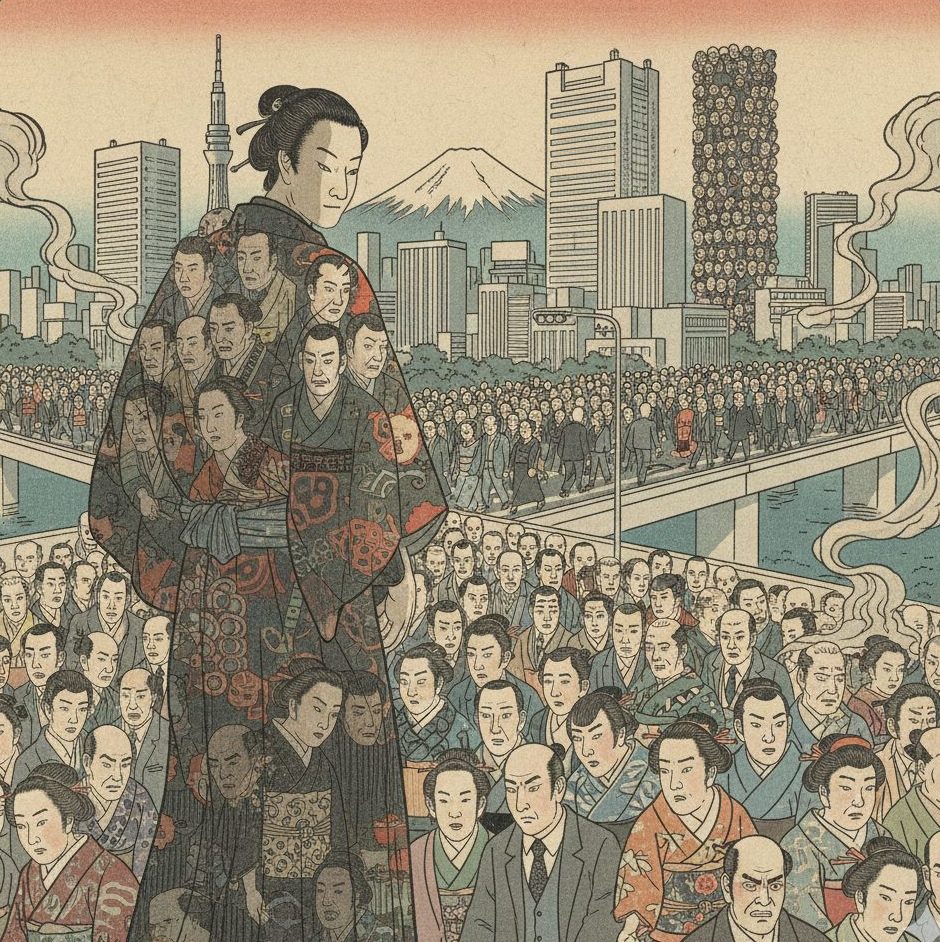
■ Why Do Japanese Groups Look “Intimidating”?
A group of Japanese people can create a sense of stillness and unity that feels almost mysterious.
To an outside observer, this collective quietness sometimes appears strict or overwhelming.
Several cultural and psychological factors shape this impression.
Let’s break them down.

■ 1. The Culture of “Reading the Air” Creates Uncanny Unity
In Japan, social harmony often outweighs individual expression.
People adapt their behavior based on the shared atmosphere, even without speaking.
This results in:
- synchronized behavior without verbal cues
- minimal unnecessary movement
- subtle reactions that align with the group
Such uniformity can appear impressive but also “too coordinated,” which some interpret as intimidating.
■ 2. Silence Becomes Pressure When Shared by a Group
Silence in Japan often functions as politeness or respect.
However, silence within a group carries a different emotional weight.
- the entire group stays quiet
- facial expressions remain controlled
- reactions become restrained
This “collective silence” can be perceived as coldness or rejection, even when no negative intent exists.
■ 3. Strong Group Harmony Makes External Changes Noticeable
When group balance is prioritized, unfamiliar people or unexpected changes stand out more.
This can lead to:
- suddenly quieting down when outsiders appear
- cautious behavior until the situation is understood
- a protective instinct to maintain internal order
These reactions are rooted in stability, not hostility, yet they may appear unwelcoming.
■ 4. Roles Over Personalities — The Group Becomes One Body
In many Japanese settings, “roles” can temporarily overshadow personal individuality.
Examples include:
- someone who maintains order
- someone who observes quietly
- someone who supports harmony behind the scenes
When these roles emerge naturally, the group acts with unity.
To outsiders, this may look like a single organized entity—strong, quiet, and hard to approach.
■ 5. Politeness Creates Distance and a Sense of Formality
Japanese politeness often involves:
- not speaking unnecessarily
- limiting emotional expression
- waiting for the right timing to respond
Individually、this signals respect.
But when practiced by an entire group, it can resemble a formal wall of calm—impressive yet difficult to read.
This ambiguity can easily be interpreted as “intimidation.”
■ 6. A High Value on Order Creates Impressive Discipline
Groups in Japan often move with a natural sense of order:
- coordinated lines
- efficient movement
- quiet transitions
This disciplined flow can remind observers of an organized unit.
It feels strong, controlled, and composed—qualities that can be misread as “strict” or “scary.”
■ Conclusion: Not Fear, but “Quiet Strength”
The impression that Japanese groups are intimidating does not come from aggression.
It emerges from:
- harmony
- silence
- politeness
- cautiousness
- order
These values produce a unique presence—a quiet strength that can seem overwhelming from the outside.
In reality、Japanese groups are not “scary.”
They are simply shaped by a cultural preference for balance, calmness, and subtle communication.
This silent unity is not a threat—
it is one of the most distinctive forms of Japanese beauty.