

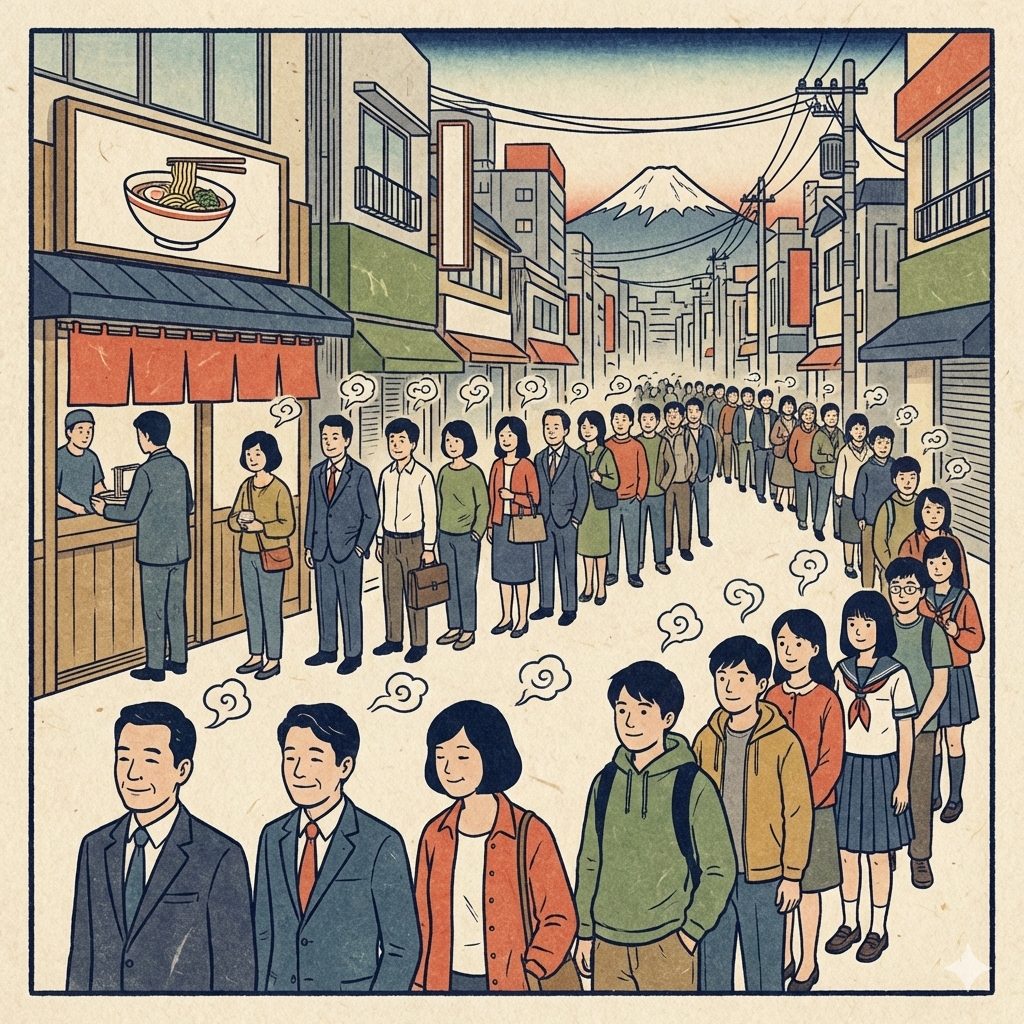
Why Do We Instinctively Seek Out the “End of the Line”?
Walking down the street, you suddenly spot a long line. Even if you don’t know what the shop is, haven’t you ever stopped in your tracks thinking, “Huh, is something going on here?”
Bubble tea, premium bread, trendy ramen shops, and the latest iPhone release…
This culture of lining up often surprises foreigners, who remark that “Japanese people are the most patient in the world.” But it’s not simply explained by “patience” alone.
Hidden within it are five powerful psychological triggers that our brains react to automatically.
Let’s unravel the true reason Japanese people find themselves drawn to lines.
Unconscious Reactions! 5 Psychological Reasons We Join Lines
We’ve categorized the reasons we instinctively seek out the “end of the line” signboard into five psychological aspects.
① Social Proof: “Everyone’s in line = It must be good”
Psychology includes the concept of “social proof.” This is the tendency to judge the actions of those around us as correct.
- A shop with ten people in line must be “delicious,” surely, rather than one with no one at all.
- Trusting the majority’s choice carries less risk than relying on your own judgment. This assumption triggers a “self-perpetuating queue,” making the line even longer.
② Loss Aversion: “If I don’t line up now, I’ll miss out”
Humans possess a loss aversion bias where the desire to avoid loss (“not wanting to lose”) is stronger than the desire to gain.
The fear of being left behind – “If I skip this, I might never get it” or “I don’t want to be the only one missing out on the trend” – drives people toward the line.
③ Justifying effort: “The harder you work, the more valuable it becomes”
“I waited two hours—it has to be delicious!”
This is a phenomenon called cognitive dissonance resolution. By paying the “effort” of waiting, the brain seeks to find value in the object commensurate with that effort. As a result, it is remembered as being several times more delicious or valuable than it would be if eaten under normal circumstances.
④ The strange solidarity of shared waiting time
Queuing isn’t a solitary battle. Sharing the time spent “waiting for the same goal” with friends, family, or even strangers creates a sense of pseudo-solidarity.
Queues also function as spaces for empathy, where people think, “It’s tough, but everyone’s hanging in there.”
⑤ The desire for recognition: wanting to show off “myself waiting in line”
In the SNS era, queues are prime content. Posts like “I’m waiting in line for the trending ○○ right now!” prove you’re at the forefront of trends.
The desire for recognition – wanting someone to acknowledge “myself with the passion to wait in line” or “myself who got the popular item” – becomes the energy source to endure the long wait.
Queues are now an “attraction”
For many Japanese today, queues have evolved beyond mere “waiting time” into the event itself—an experiential activity.
Queues of the past arose simply from shortages or inefficiency. Modern queues are different.
- The anticipation while waiting
- The excitement of gradually approaching the storefront
- The sense of accomplishment upon finally obtaining the item
These feelings mirror those experienced during theme park wait times.
It’s no exaggeration to say we pay not just for the product itself, but for the “story of getting it through the queue.”
Queuing is the ultimate “pastime” and a luxurious “consumption of time.”
Enjoying queues is proof of affluence
While some criticize “Japanese people queue too much,” the flip side is that it means there’s an abundance of “attractive things worth queuing for.”
Next time you see a line, try thinking this:
“Ah, right now, five psychological mechanisms are firing on all cylinders in my brain.”
What awaits beyond the line isn’t just ramen or sweets.
It’s the conviction that “my choice was right” and a small sense of accomplishment.
That, perhaps, is the true essence of what we seek when we join the end of the line.
So, which line will you join on your next day off?