

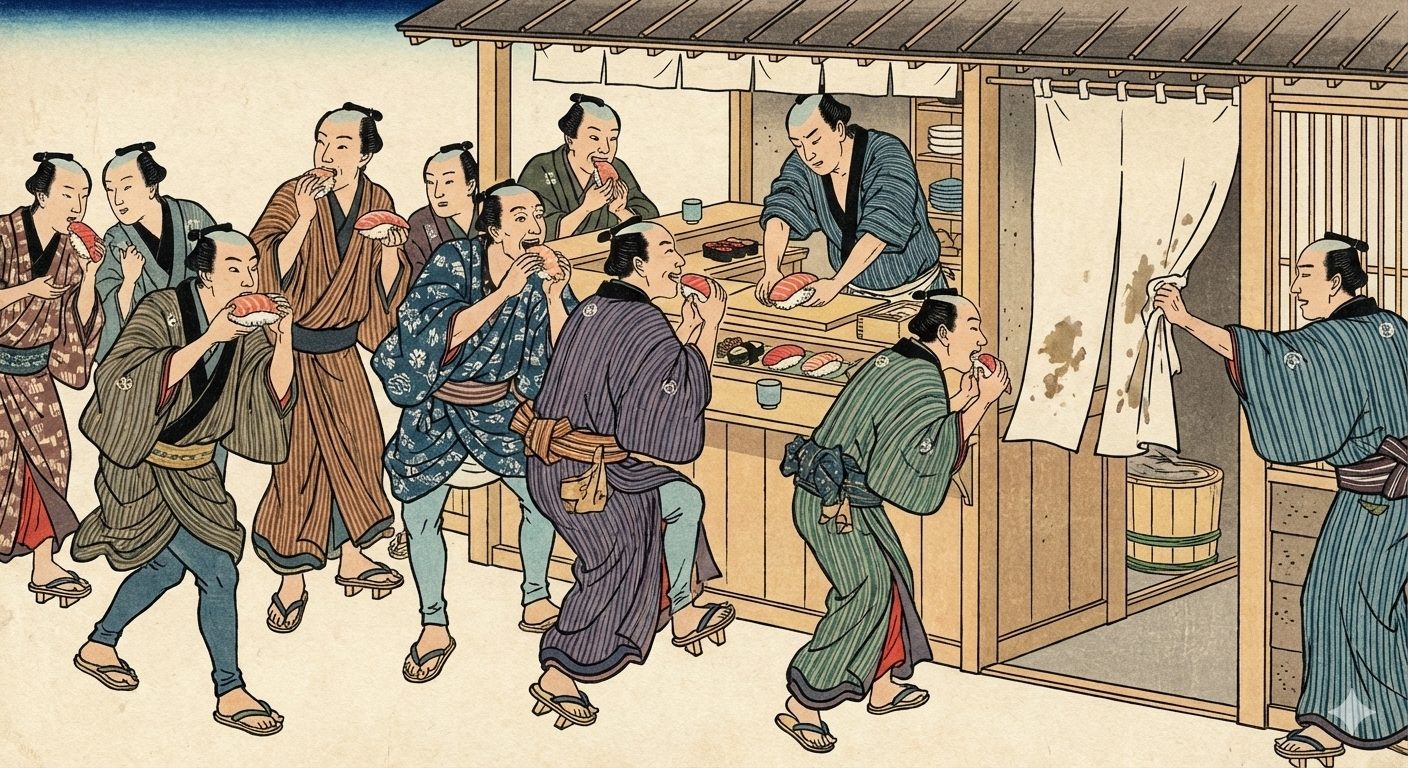
High-end “nigiri sushi” was actually Edo-period convenience store food?
In modern times, “sushi” evokes images of a bit of luxury at non-conveyor-belt restaurants, or a family event even at conveyor-belt sushi places.
But go back about 200 years in history. For people in the Edo period, nigiri sushi was like “a quick bite grabbed at a street stall during work breaks—the equivalent of today’s convenience store rice balls.”
Why did it evolve into a luxury item? Why was old-style sushi so large?
This time, we’ll unravel the fast-food scene of Edo—knowledge that will make your sushi taste even better.
1. [Beginning] The “Impatient Edoites” Who Revolutionized Sushi
Originally, “sushi” was a preserved food called “narezushi,” made by fermenting fish with rice and salt over a long period. It was a food requiring immense patience, taking months or even a year to complete.
However, the impatient Edoites, who “hated waiting,” weren’t going to stand for that.
“We want it faster!”
“Who has time to wait for fermentation?!”
Responding to this demand, “nigiri sushi” was born in early 19th century Edo (present-day Tokyo). It involved placing raw fish toppings on vinegared rice and firmly shaping it on the spot.
It was a revolutionary invention born from the Edoites’ impatience—a trait that resonates even with modern people who value time performance.
2. 【Continuation】The Legendary Craftsman “Hanaya Yohei” and the Giant Single Piece
The legendary sushi craftsman Hanaya Yohei devised this “nigiri sushi” and sparked an explosive boom.
His stall “Yohei Sushi” in Ryogoku drew massive lines daily. However, the sushi of that era looked quite different from what we eat today.
Shockingly large: One piece was rice ball-sized!
Sushi back then was a whopping 2 to 3 times larger than today’s portions.
It was about the size of a small rice ball, and cutting it in half to serve is said to be the origin of the current “two pieces per plate” practice.
Soy Sauce Was “Brushed On,” Not “Dipped”
Instead of the modern style of taking soy sauce from a small dish, it was common for the chef to brush soy sauce (simmered soy sauce) onto the topping beforehand. This was a thorough fast-food approach, allowing busy customers to stop briefly and pop it straight into their mouths.
3. 【Transition】“The dirtier the noren, the better the shop”!? Unique Edo-period anecdotes
Edo-period sushi stalls featured “manners” and “scenes” that would shock modern sensibilities.
Using the shop’s noren as a hand towel!?
At the time, stall sushi was fundamentally “stand-up eating” and “eaten by hand.”
There were no disinfectant wipes like today. After finishing their sushi, customers would actually wipe the soy sauce off their fingertips on the shop’s “noren” curtain before leaving.
In other words, it was said that “the more soy sauce-stained and blackened the noren, the more customers the shop had, proving it was a thriving establishment.” While this would be a major hygiene issue today, for Edo locals, it served as their very own gourmet guide.
Why the Toppings Were “Red”
Back then, sushi wasn’t made with white vinegared rice like today; reddish “red shari” was the norm.
The reason? They used inexpensive “red vinegar” made from sake lees instead of the pricier rice vinegar. Cheap and tasty—it was truly the commoner’s ally.
4. [Conclusion] Savoring the “Elegance of Edo” Taken a Step Further
Nigiri sushi, which began at street stalls, evolved through the Meiji, Taisho, and Showa eras. Alongside advances in preservation techniques and distribution, it matured into the high-end “itamae cuisine.”
However, at its core lies the same spirit Yohei had when he first started: “Serving the freshest ingredients, prepared with artisan skill, at their absolute peak of deliciousness.”
The next time you sit at a sushi counter, or gaze at the conveyor belt at a conveyor-belt sushi restaurant, please remember this.
“Even Edo locals 200 years ago waited for sushi with this same sense of excitement.”
Thinking this way might just make your usual piece taste a little more “refined.”
Japanese-style wabi-sabi goods now available!
Welcome to WABISABIMOMENTS! Discover Japanese-inspired beauty through our curated selection of home goods and apparel.
Find items to soothe your mind and body!
