

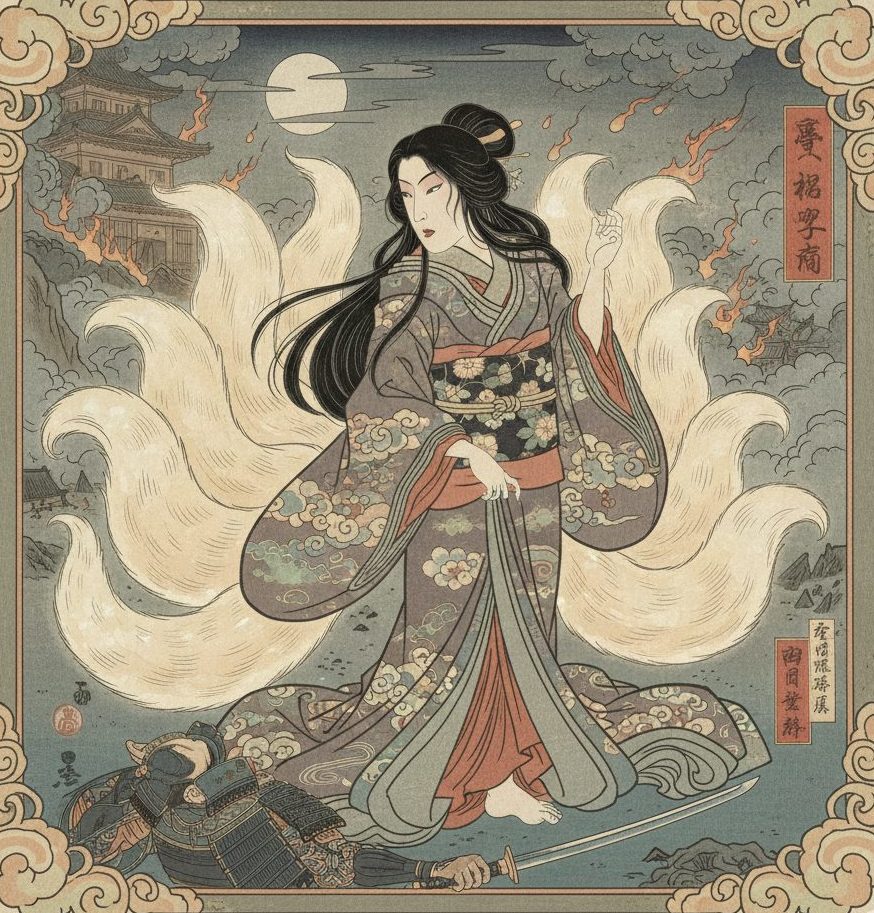
Introduction: A Beautiful Woman with a Deadly Secret
Throughout East Asian folklore, few mythical beings evoke as much fascination and fear as the nine-tailed fox. Known in Japan as the kyūbi no kitsune, this mysterious creature often appears as an extraordinarily beautiful woman who hides a terrifying secret. While captivating in appearance, the nine-tailed fox is a supernatural entity with immense power, cunning intelligence, and, in many legends, malicious intent.
This article explores the legend of the nine-tailed fox as it appears in Japanese mythology, its symbolic significance, and its connection to real historical events—most notably, the story of Tamamo-no-Mae, a woman whose beauty veiled a darker truth.
What Is the Nine-Tailed Fox?
The nine-tailed fox, or kyūbi no kitsune (九尾の狐), is a supernatural creature that originates from Chinese mythology and was later incorporated into Japanese and Korean folklore. These fox spirits are said to become more powerful with age, growing an additional tail every hundred years. At their most powerful state—with nine tails—they are nearly divine, possessing abilities like shape-shifting, mind control, and immense magical strength.
While some fox spirits in Japanese folklore (zenko) are benevolent and serve the deity Inari, the nine-tailed fox is often categorized as a yako or nogitsune, representing mischief, deception, or outright evil.
The Tale of Tamamo-no-Mae: The Most Famous Nine-Tailed Fox in Japan

One of the most well-known stories featuring the nine-tailed fox in Japan is the legend of Tamamo-no-Mae. During the Heian period (794–1185), Tamamo-no-Mae appeared in the imperial court as a stunningly beautiful and intelligent woman. She quickly became a favorite of Emperor Toba, admired for her grace, wit, and charm.
However, strange events began to unfold at the court. The emperor fell gravely ill, and no physicians could identify the cause. A powerful onmyoji (a practitioner of Japanese esoteric cosmology) was summoned to investigate. Through spiritual divination, it was revealed that Tamamo-no-Mae was not a human at all but a nine-tailed fox in disguise, feeding off the emperor’s life force.
Exposed, she fled the court and was eventually hunted down in the plains of Nasu (present-day Tochigi Prefecture), where she was killed. Her spirit was said to have lingered in a stone called the Sesshō-seki (Killing Stone), which would kill anyone who touched it.
Symbolism of the Nine-Tailed Fox
The nine-tailed fox carries complex symbolism in Japanese culture. On one hand, it represents wisdom, transformation, and longevity. On the other, it is associated with deception, seduction, and danger. The dual nature of the fox reflects both the admiration and fear it evokes.
In literature, the nine-tailed fox often serves as a metaphor for political manipulation, inner corruption, or hidden power. The tale of Tamamo-no-Mae can be seen as a cautionary story about how beauty and charm can mask dangerous intentions.
Cultural Influence and Modern Interpretations
The legend of the nine-tailed fox remains deeply ingrained in Japanese popular culture. It frequently appears in:
- Anime and manga: Characters inspired by kitsune often possess supernatural powers or ambiguous morality.
- Video games: The nine-tailed fox features in games such as Pokémon, Final Fantasy, and League of Legends.
- Traditional art and theater: Ukiyo-e prints and Noh plays have depicted the story of Tamamo-no-Mae and her transformation.
In recent years, the figure of the nine-tailed fox has also gained popularity in global media, often portrayed with more sympathetic traits—transforming it from a villain into a complex antihero or misunderstood being.
The Sesshō-seki (Killing Stone): Folklore Meets Reality
One fascinating aspect of the legend is its link to a real place: the Sesshō-seki in Nasu. This volcanic rock, said to contain the spirit of Tamamo-no-Mae, has been a site of myth and pilgrimage for centuries. Visitors believed the stone emitted toxic gas and was cursed.
In 2022, the stone made headlines when it unexpectedly split in half, leading to a flurry of speculation that Tamamo-no-Mae’s spirit had finally been released. While geologists attributed the event to natural weathering, the legend once again sparked widespread public interest.
Conclusion: Beauty, Power, and the Shadows of Legend
The nine-tailed fox continues to enchant and unsettle us because it touches on universal themes—beauty concealing danger, intelligence used for manipulation, and the blurred line between good and evil. Through the lens of Tamamo-no-Mae’s story, we see how myth and reality often intertwine, shaping cultural memory and moral lessons that endure for centuries.
Whether as a historical figure of intrigue or a supernatural icon of caution, the nine-tailed fox remains one of Japan’s most compelling legends—reminding us that appearances can be deceiving, and some truths are far older than we imagine.