

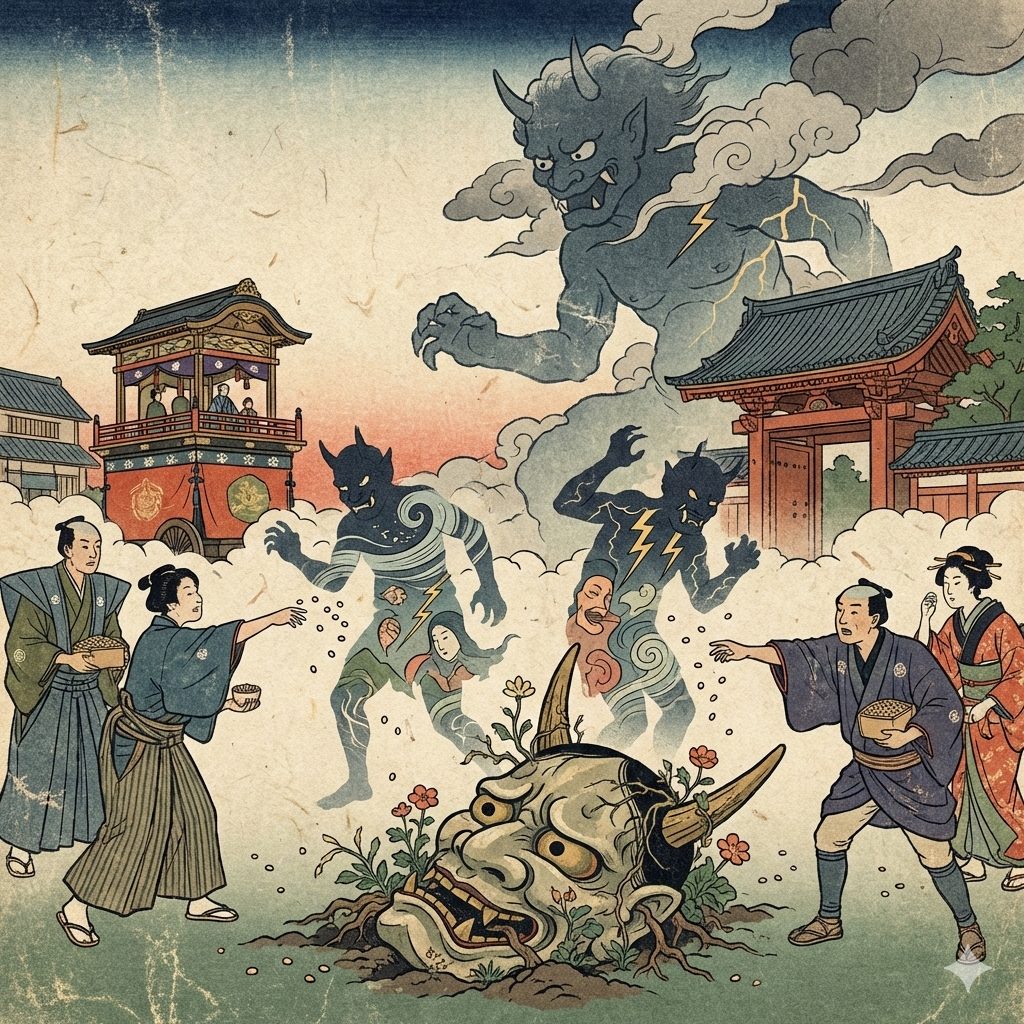
Oni Were Not Just Monsters
When you hear the word “Oni,” you might picture fearsome creatures with red or blue faces.
However, in ancient Japan, Oni were not simply monsters.
They symbolized invisible fears such as natural disasters, epidemics, and famine—forces beyond human control.
By giving these fears a visible form, people found a way to confront and manage their anxieties.
Some theories suggest that the word “Oni” comes from “Onu,” meaning “something hidden or invisible.”
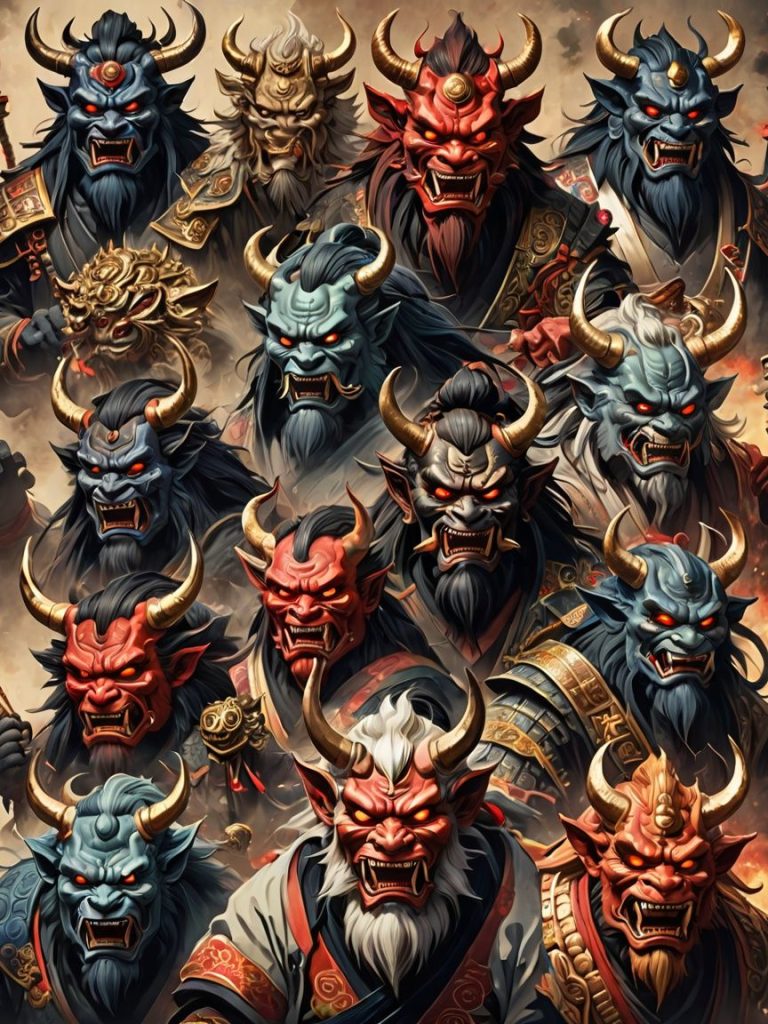
Oni as Beings for Good Harvests and Evil-Repelling Rituals
Oni were seen not only as fearsome beings but also as powerful spiritual entities.
They played vital roles in rituals meant to pray for good harvests and to ward off evil spirits.
For instance, during Setsubun, beans are thrown while chanting “Oni wa soto, Fuku wa uchi” (Demons out, Good fortune in).
This practice symbolizes driving away evil and inviting good fortune into the home.
Oni were seen as carriers of misfortune, but also as beings capable of absorbing and taking away that misfortune.
Namahage in Akita Prefecture and the Role of Oni
A well-known example is the “Namahage” tradition from Oga Peninsula, Akita Prefecture.
During New Year’s Eve, men dressed as Oni visit households, shouting “Are there any lazy children?” or “Are there any bad kids?”
This tradition encourages children to behave properly and brings wishes for family health and safety.
In 2018, Namahage was inscribed on UNESCO’s Intangible Cultural Heritage list, highlighting its cultural importance.
Here, too, Oni are not mere threats but play positive educational and ritual roles.
Oni and Evil-Repelling Practices Seen in Setsubun
The custom of bean-throwing during Setsubun directly reflects the association between Oni and evil spirits.
Seasonal changes, particularly at the beginning of spring, were thought to invite disorder and chaos.
By scattering roasted soybeans while chanting, people tried to purge bad luck and purify their living spaces.
In this way, Oni were targeted as symbols of calamity but were essential figures in the effort to protect households from harm.
The Changing Appearance of Oni Through History
The image of Oni evolved over time.
In early texts like the “Nihon Shoki” and “Fudoki” from the Nara period, Oni were depicted as invisible spiritual beings.
However, by the Heian period, they took on the more familiar image: horned figures wearing tiger-skin loincloths.
This shift was influenced by Buddhism and Onmyodo (the way of Yin and Yang), which placed strong significance on directions and spiritual forces.
Notably, the “Kimon,” or the northeast direction, was feared as the gateway through which evil would enter.
Modern Echoes of Oni Culture
Even today, Oni culture is alive through festivals like Setsubun and Namahage.
Beyond traditional rituals, Oni appear widely in modern media such as anime, movies, and novels.
Popular works like “Demon Slayer: Kimetsu no Yaiba” reimagine Oni, portraying them not merely as villains but as beings with complex emotions and humanity.
Through such representations, Oni continue to capture the imagination of modern audiences.
The Dual Nature of Oni
One of the most fascinating aspects of Oni is their dual nature: they were both feared and respected.
In many traditional festivals, people would impersonate Oni to cleanse communities of evil influences.
This paradox—being both terrifying and protective—mirrors humanity’s approach to natural disasters and uncontrollable forces.
Rather than simply fearing the unknown, ancient Japanese tried to acknowledge, manage, and even collaborate with it symbolically.
The Relationship Between Japanese People and Oni
The Japanese relationship with Oni was never purely adversarial.
Rather, Oni served as a visible form of adversity that people could confront through rituals.
This reflects a uniquely Japanese approach to nature and fate: not by rejecting or fighting against overwhelming forces, but by coexisting with them.
The affection and familiarity often shown toward Oni today stem from this cultural perspective.
Conclusion
In Japan, Oni were never just simple monsters or mindless sources of terror.
They were embodiments of unseen dangers and natural phenomena, made visible so that people could understand and confront their fears.
Through events like Setsubun and Namahage, Oni became central figures in community protection and purification rituals.
Even today, their images continue to evolve, yet their deep cultural significance remains unchanged.
Oni, with their combination of fear and reverence, embody a profound aspect of Japanese spirituality and resilience.
As times change, the stories and traditions surrounding Oni will surely continue to inspire and connect people to the past and to each other.